Silicone Parchment Rolls for Sheet Pans and Convection Ovens
A silicone parchment roll is bleached white parchment with a silicone coating, wound on a core so you tear what the pan needs. It releases cookies, roasted vegetables and sticky glazes without oil and holds up under a 450°F convection fan.
From $0.30 a sheet; rolls are priced by the roll on the quote. Written quote in one business day and a free design proof.
Specifications
| Stock | Bleached white parchment (unbleached on request) |
|---|---|
| Coating | Silicone, one side or both sides |
| Heat (typical) | To 450°F; not for broilers or open flames |
| Typical weight | About 35–45 lb basis weight |
| Roll sizes | 15, 18 and 24 in wide; 164 ft or 1,000 ft long |
| 1–4 food-safe colors, step-and-repeat along the roll | |
| Packing | One roll per dispenser box with a tear bar |
| Minimum | 1 roll; 4–6 business days after proof approval |
Silicone parchment rolls are continuous lengths of silicone-coated parchment, usually 15 to 24 in wide and 164 to 1,000 ft long. You tear or cut a piece to fit the pan, bake on it, and often get a second or third bake from the same piece. They suit kitchens that run several pan sizes and do not want to stock a cut sheet for each.
Why a silicone roll instead of cut sheets
A kitchen with quarter, half and full sheet pans either stocks three sheet sizes or runs one roll. The roll wins on shelf space and on the day the half-sheet box runs out mid-service.
Torn to length and laid coating-up, the paper takes a 450°F convection bake without browning and lets a sugar-edged cookie or a glazed fillet lift off dry. The pan under it stays clean.
Order by width first: the roll should clear the shorter side of your largest pan by about an inch. Length is a stock decision, 164 ft for a small kitchen, 1,000 ft where pans go through by the hundred.
Sizes and formats
| Format | Typical size | Typical use |
|---|---|---|
| Roll | 15 in × 164 ft | Counter roll |
| Roll | 18 in × 164 ft | Prep station roll, the usual pick |
| Roll | 18 in × 1,000 ft | Dispenser roll |
| Roll | 24 in × 1,000 ft | Dispenser roll for full sheet pans |
Sizes are typical starting points. Any other size is a custom cut; ask on the quote.
See all sizesDesign Your Custom Silicone Parchment Rolls
Drop your logo on silicone parchment rolls to see how the print looks before you ask for the quote.
What a silicone parchment roll is
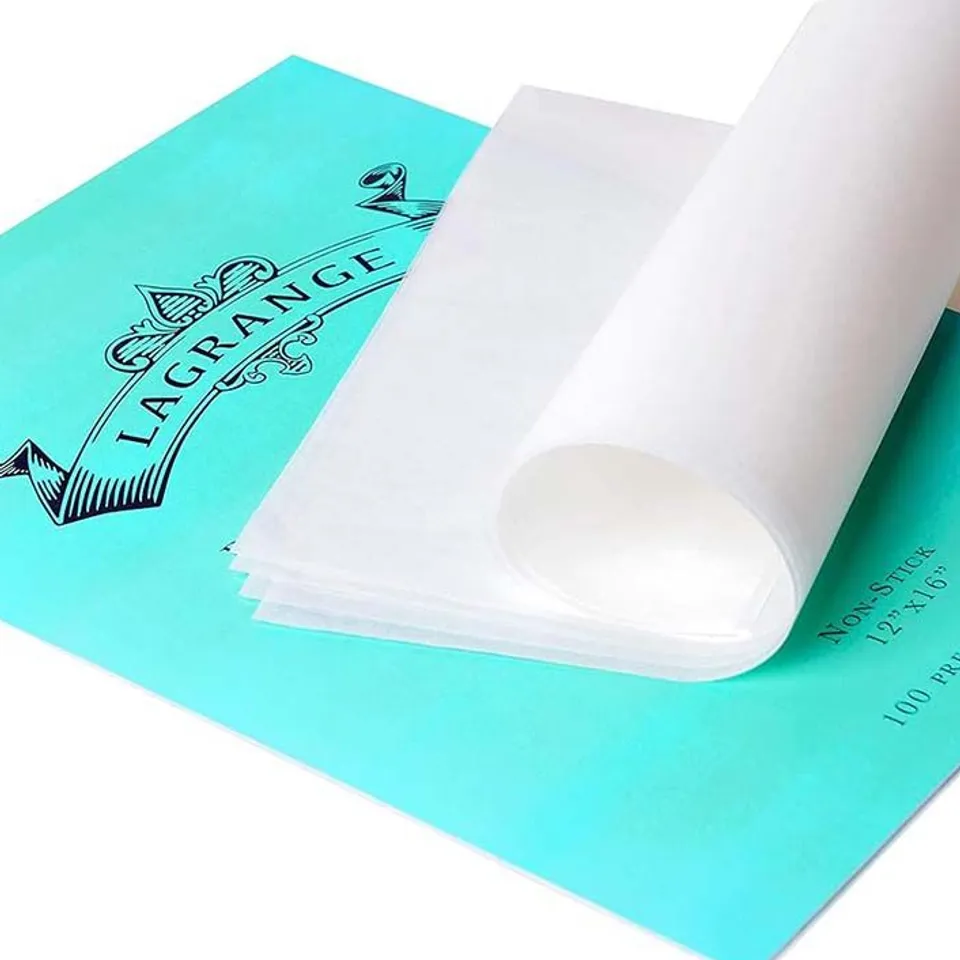
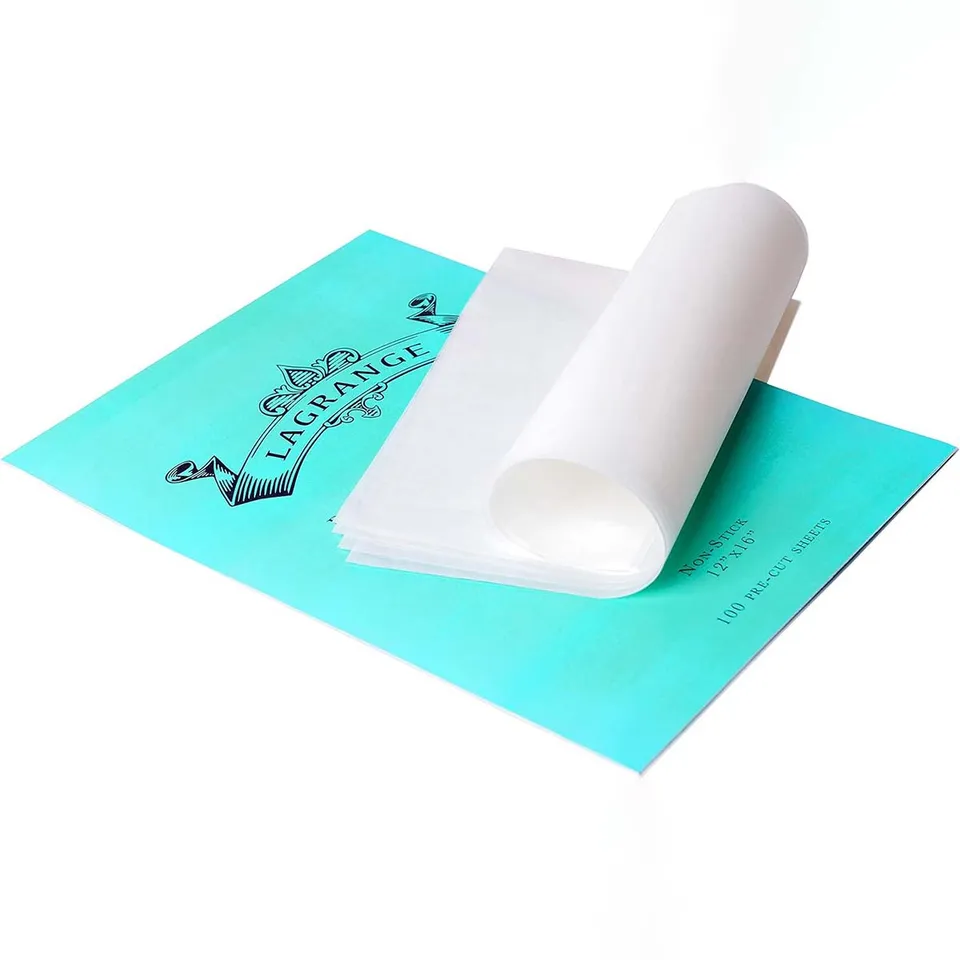
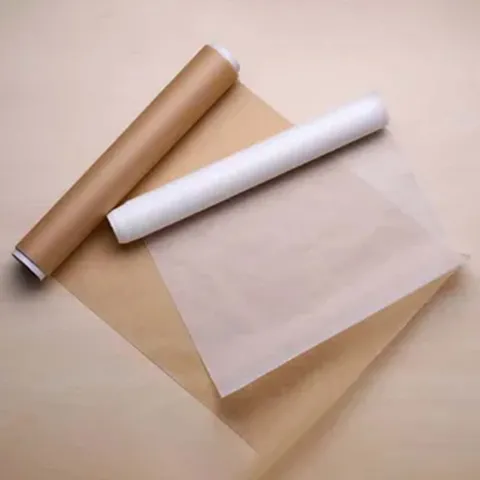
Silicone parchment rolls are bleached white parchment, run through a silicone coating and wound onto a cardboard core. The paper in the photos is the same stock: smooth, slightly translucent, with a faint sheen on the coated face.
Kitchens that run three or four pan sizes buy rolls because one roll covers all of them. A pizzeria tears a long strip for a 16 by 24 in pan, then a short one for a quarter pan, from the same box, and nothing sits half used in a drawer.
Bakeries with convection decks, meal-prep operations and caterers who roast on full sheets are the usual buyers. A roll suits a kitchen that would rather cut than stock four sheet sizes.
How does silicone parchment behave at 450°F?
The silicone coating gives a dry release. A cookie with a sugar edge lifts clean, a glazed salmon fillet slides onto the plate, and the pan under it needs a wipe rather than a soak.
Typical trade figures put silicone-coated parchment at 450°F, which covers almost every convection setting a bakery or pizzeria uses. Past that the paper browns, then turns brittle, long before it catches.
Under a convection fan an uncut length can lift at the corners. A pan of batter holds it flat; an empty pan does not, so load the pan before the oven door opens. Keep the paper away from broilers and elements, and read the parchment temperature limits guide before trying a new setting.
Which roll width fits a full sheet pan?
Match width to the shorter pan side with an inch to spare, then tear to the longer side. The usual pick is 18 in by 164 ft because it covers a half sheet across and a full sheet along.
| Roll size | Pan it suits | Pieces per roll (typical) |
|---|---|---|
| 15 in × 164 ft | Quarter and half sheet pans, 12 × 16 in | About 120 half-sheet pieces |
| 18 in × 164 ft | Full sheet pans, 16 × 24 in; the usual pick | About 80 full-sheet pieces |
| 18 in × 1,000 ft | Full sheet pans in high-volume kitchens | About 500 full-sheet pieces |
| 24 in × 1,000 ft | 18 × 26 in pans and wide roasting trays | About 460 edge-to-edge pieces |
Count your pans per day, multiply by the days between deliveries, and pick the length that lands above that number. The sheet sizes by pan chart lists the common pans if you are unsure which you run.
Bleached white or unbleached on the roll?
Most silicone rolls are bleached white, and that is what the photos show. White reads clean on a bakery pass and shows a printed logo in true color.
Unbleached kraft-tone parchment can be silicone-coated too, and it suits a rustic deli counter or a pizzeria that boxes slices on paper. Ask for it on the quote; the typical heat figure drops to about 420°F.
Coating on one side is the usual choice for lining pans. Both-sides coating costs more and matters only when you fold paper over the food, as with a parchment-wrapped fish, or stack hot items between layers. The silicone, Quilon and unbleached comparison walks through the trade-offs.
Can you reuse a piece torn from a silicone roll?
Yes, within reason. A piece that baked cookies or bread comes off the pan dry and flat and will take a second and often a third bake.
Retire it once it darkens, smells toasted or has a greasy patch from cheese or glaze. Pieces that held raw meat or fish are single use.
Reuse is where a silicone roll pays for itself against a Quilon roll, which gives one bake per piece. Count the bakes over a week and the silicone roll usually comes out ahead on a kitchen that bakes dry goods.
Wipe a reused piece with a dry towel between bakes; water under the paper steams and lifts it. Stack spent pieces coating to coating so they stay flat for the next pan.
Printing a logo along a silicone roll
A roll is printed step-and-repeat: your mark repeats every few inches along the length, so wherever you tear, a logo lands on the piece. Single-position logos belong on cut sheets, not rolls.
Ink goes on the uncoated face, the side that faces away from the food. One or two colors in food-safe soy or water-based ink, matched to Pantone solid-coated references, is the usual run; four is the limit.
Send vector artwork, keep lines above 0.5 pt, and expect halftones to soften on a translucent sheet. The guide to printing a logo on parchment covers file setup.
Dispenser boxes and tearing a straight edge
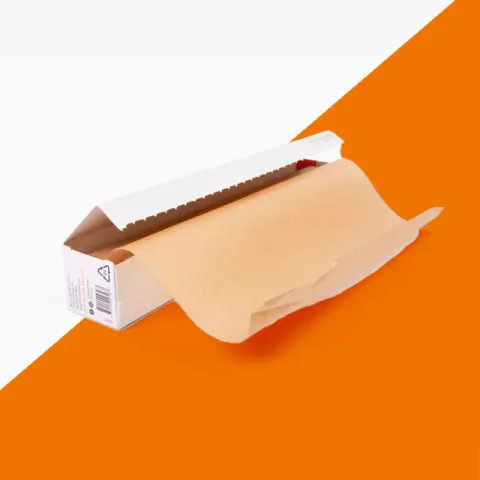
Each roll ships in a box with a serrated tear bar. Pull the paper against the edge in one motion; a slow saw leaves a ragged line that curls in the oven.
- Mount the box at waist height near the pan rack, not above the range, where steam softens the paper.
- Feed the roll from the bottom of the box so the piece lies coating-up on the pan.
- Mark the box edge with the lengths you tear most, 16 in and 24 in, using a marker.
- Keep the roll in its box; a loose roll picks up flour and unwinds on the shelf.
- Order the 1,000 ft length only if the box fits your rack; it is heavier and about twice the diameter.
Mistakes to avoid with silicone parchment rolls
The common one is running the paper under a broiler to finish a dish. Silicone parchment handles 450°F in an oven cavity; direct radiant heat from an element scorches it in seconds.
The second is tearing short. A piece that stops an inch from the rim lets batter run under the paper and bake onto the pan, which costs more scrubbing than the inch saved.
Third, buying a 24 in roll for 18 in pans because it seems safer. The overhang flaps in the fan and shades the edge of the bake. Width should match the pan, not exceed it by much. Kitchens that only run half sheets are better served by pre-cut parchment sheets for sheet pans.
How to order a silicone parchment roll
From $0.30 a sheet; rolls are priced by the roll on the quote, and the exact figure arrives in writing within one business day. The minimum is one roll, and you pay by invoice after approving the quote and the proof.
- Tell us the width, length, stock and whether one or both faces are coated.
- Send artwork if the roll is printed, or say plain if it is not.
- Approve the free design proof; edits at this stage are unlimited.
- Production takes 4 to 6 business days after approval.
- Free tracked delivery reaches any US address in 2 to 3 business days.
A roll that arrives crushed or misprinted is reprinted or refunded when you send photos within 10 days. Start with the silicone roll quote form or call (503) 461-4788, Monday to Friday, 9 am to 6 pm Eastern.
Silicone Parchment Rolls questions
How long is a silicone parchment roll?
Typical silicone parchment rolls run 164 ft or 1,000 ft long, in 15, 18 or 24 in widths. Other lengths are a custom run; ask on the quote.
Is the silicone coating on one side or both sides of the roll?
One side is standard and is what most pan lining needs. Both-sides coating is available for wrapping or stacking hot food.
What temperature can a silicone parchment roll take?
Typical trade figures put silicone-coated parchment at 450°F in an oven cavity. Keep it clear of broilers, open flames and heating elements.
How many full-sheet pieces come off an 18 in by 164 ft roll?
About 80 pieces at 24 in long. A 1,000 ft roll of the same width gives about 500.
Can a silicone parchment roll be printed with my logo?
Yes, as a step-and-repeat pattern along the length in 1 to 4 food-safe colors. The logo repeats so it lands on every piece you tear.
Does the silicone roll come in a dispenser box?
Each roll ships in a box with a serrated tear bar. Keep the roll inside it to tear straight pieces and keep flour off the paper.
Is there a silicone roll in unbleached parchment?
Yes, unbleached kraft-tone parchment can carry a silicone coating. Its typical heat figure is about 420°F rather than 450°F.
Why does paper from the roll lift under my convection fan?
An empty pan lets the fan get under the corners. Load the pan before it goes in, or tuck the ends under the pan rim.
What is the minimum order for silicone parchment rolls?
One roll. Mixed widths on one order are fine, each at one roll minimum.
How do I work out which roll width I need?
Measure the shorter inside dimension of your largest pan and add about an inch. For a 16 by 24 in full sheet pan that points to the 18 in roll.
How many bakes can one piece from a silicone roll do?
Two or three dry bakes is typical, such as cookies or bread. Retire it once it darkens or picks up grease, and never reuse after raw meat.
How soon does a silicone roll order arrive?
Production takes 4 to 6 business days after proof approval, then free tracked delivery in 2 to 3 business days to any US address.
Something else? Ask us on WhatsApp or call (503) 461-4788.
Tell us what you bake or wrap
Send the parchment, a size and a quantity, plus a logo if you have one. We reply in writing within one business day with a price and a free design proof. Prefer to talk? Call (503) 461-4788 or message us on WhatsApp.