Parchment Pan Liners Cut to Your Pan
Parchment pan liners are cut to the floor of a specific pan, with square corners, cut corners or lift tabs. Drop one in, pour the batter and the slab lifts out whole when it has cooled.
From $0.30 a liner. Written quote in one business day and a free design proof.
Specifications
| Format | Liner cut to pan size: straight, cut corners or lift tabs |
|---|---|
| Stock | Bleached white or unbleached kraft-tone parchment |
| Coating | Silicone one or both sides, or Quilon |
| Heat (typical) | Silicone 450°F typical; Quilon or unbleached 420°F |
| Typical weight | About 35–45 lb, a little heavier so tabs do not tear |
| Typical sizes | 8 × 8, 9 × 13, 12 × 16, 16 × 24 in; other pans quoted |
| One to four food-safe ink colors on the outer face | |
| Minimum and lead time | 1,000 liners; 4–6 business days after proof approval |
A parchment pan liner is a sheet of coated parchment cut to one pan size rather than a general sheet size. The corners are notched or folded so the liner sits flat on the floor and up the sides without bunching. Brownie pans, quarter sheet pans and slab cake pans are the common homes for it.
Why a cut liner instead of a sheet
A flat sheet in a brownie pan bunches at the corners and leaves a fold mark baked into the edge of every bar. A liner with cut corners folds up the sides clean, so the slab comes out square.
Lift tabs stick up past the rim on two sides. Once the bake has cooled you pick up the whole slab by the tabs, carry it to the cutting board and portion it there instead of digging in the pan.
Send the inside measurements of the floor and the depth of the wall. The liner is cut to those numbers, and a design proof is free before the run.
Sizes and formats
| Format | Typical size | Typical use |
|---|---|---|
| Liner | 8 × 8 in | Square brownie pan |
| Liner | 9 × 13 in | Quarter sheet pan, the usual pick |
| Liner | 12 × 16 in | Half sheet pan |
| Liner | 16 × 24 in | Full sheet pan |
Sizes are typical starting points. Any other size is a custom cut; ask on the quote.
See all sizesDesign Your Custom Parchment Pan Liners
Drop your logo on parchment pan liners to see how the print looks before you ask for the quote.
A liner shaped to the pan, corners included
Parchment pan liners are cut for one pan, not for a general sheet size. The floor measurement plus the wall depth decides the cut, and the corners are notched so the paper folds up the sides without a pleat.
Brownie bakers, slab cake shops, meal-prep kitchens doing sheet-pan dinners and cafes baking bars by the quarter pan buy them. Anyone who portions a slab after baking gets the most out of the lift-tab version.
Round cake pans take a round, not a liner; those are on the parchment rounds for cake pans page. Liners cover rectangular and square pans.
Why does a pan liner creep up the rim?
A plain sheet pushed into a deep pan has nowhere for the corner paper to go, so it folds over itself and the fold lifts the sheet away from the wall. Batter runs behind it. A liner with cut corners removes that excess, so the two flaps overlap flat and the wall stays covered.
In the oven the liner behaves like any coated parchment. Silicone-coated liners are typically rated to 450°F and release a sugar-heavy brownie top without tearing. Quilon and unbleached liners are typically rated to 420°F, which covers nearly every bar, blondie and slab cake.
Moisture matters more in a liner than in a flat sheet, because batter sits against the paper on five faces. The coating keeps the paper from going soft, so the walls of the slab stay crisp instead of steamed.
Which liner fits a 9 × 13 in quarter sheet pan?
The 9 × 13 in liner is the usual pick, cut with wall flaps to the depth of the pan. Order it straight if you only want the floor covered, or with cut corners when the bake fills the pan.
| Liner size | Pan | Corner style that suits it |
|---|---|---|
| 8 × 8 in | Square brownie pan | Cut corners or lift tabs |
| 9 × 13 in | Quarter sheet pan | Cut corners, the usual pick |
| 12 × 16 in | Half sheet pan | Straight for thin bakes, cut corners for slabs |
| 16 × 24 in | Full sheet pan | Straight, floor only, for high-volume lines |
Measure the inside floor, then the inside wall height, and give us both numbers. A 2 in deep pan needs a liner with 2 in flaps; a 1 in rimmed sheet pan needs almost none. The pan size chart for liners shows the common inside measurements.
Straight cut, cut corners or lift tabs
Three cuts cover most pans. Pick by how the bake leaves the pan.
- Straight: a rectangle cut to the floor with no flaps. Cheapest, fastest, right for cookies, rolls and roasting on a rimmed sheet pan.
- Cut corners: the floor plus four flaps, with the corner squares removed. The flaps fold up and overlap at the corners so the whole inside of the pan is covered.
- Lift tabs: cut corners plus two flaps long enough to stand above the rim. Lift the cooled slab out by the tabs and portion on the board.
Lift tabs use a little more paper per liner but save a bench scraper and a broken corner on every batch.
Stock and coating for pan liners
Bleached white with silicone on one side is the standard brownie and bar liner. The release is reliable on caramel, cheesecake bars and anything with a sugar glaze that would otherwise weld to the paper.
Unbleached kraft-tone liners suit a bakery that shows the slab in the case still on its paper. Pair it with Quilon if the liners are single use, or silicone if you reuse a liner for a second tray of dry goods.
Keep every liner below its typical heat limit, and never under a broiler. The parchment temperature limits guide sets out what each coating takes.
Can pan liners be printed?
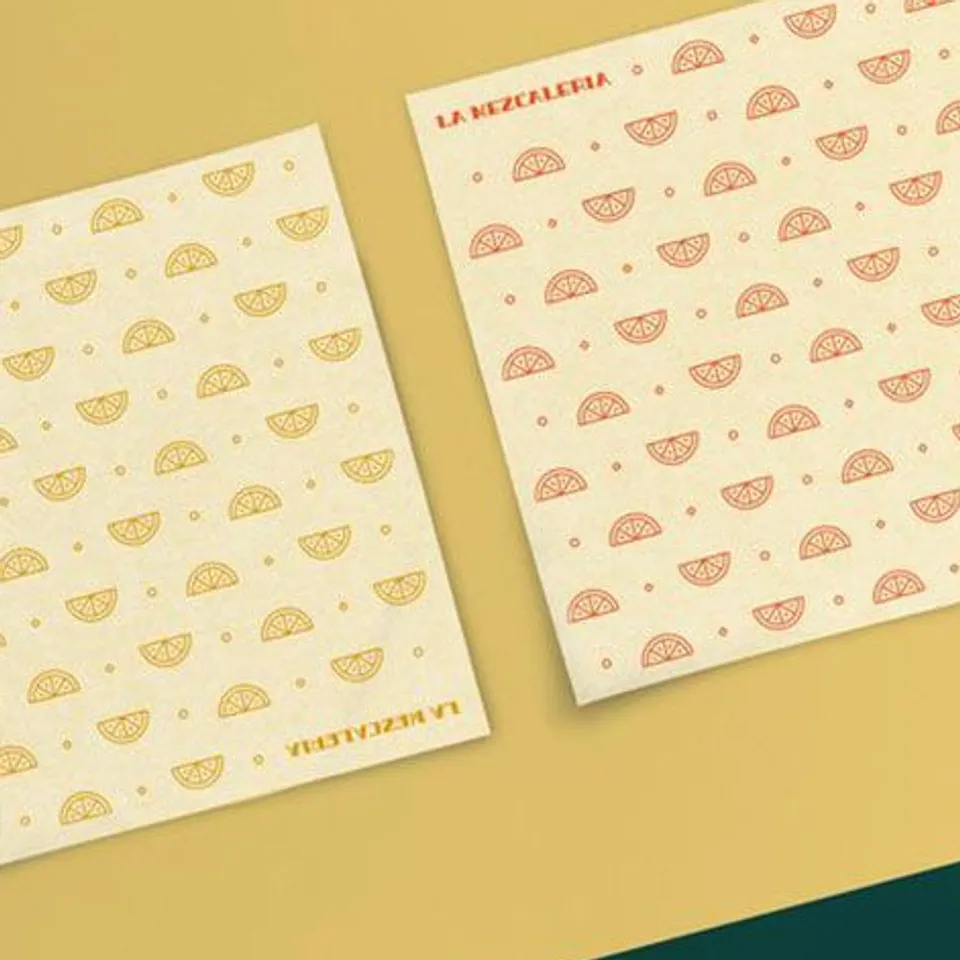
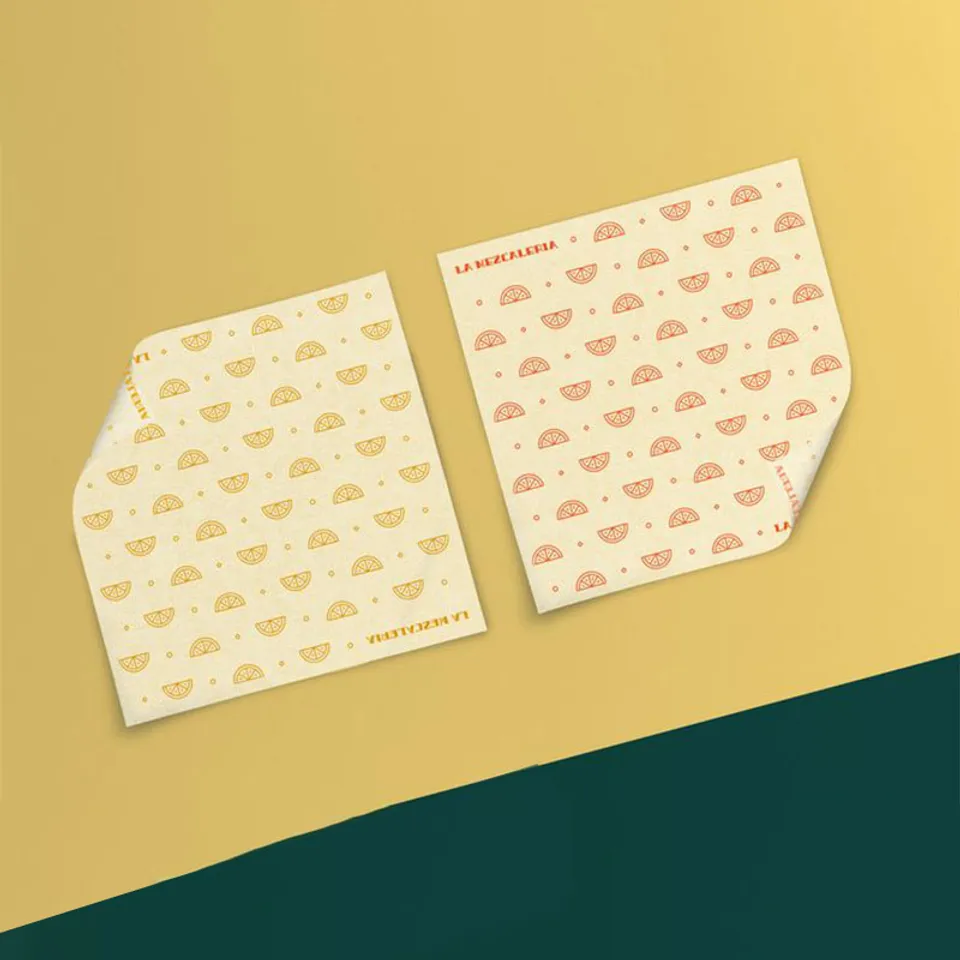
Yes, on the outer face, the side against the pan. The two sample liners in the photos carry a one-color repeat print, each in a different ink, on a light stock. That is the usual look: a small motif stepped across the paper, with the name in one corner.
Printing a liner makes sense when the slab is sold on its paper, as a tray of bars in a case or a whole sheet cake carried out in a box. The print shows at the edges and on the tabs. For a liner that is thrown away at the bench, plain stock is the better spend.
One color on unbleached, up to four on bleached white, matched to Pantone solid-coated references. Larger printed sheet formats are on the custom printed parchment paper page.
Packing and counting at the bench
Liners ship flat in cases of 1,000, stacked with the flaps unfolded so each one lies square on the next. Cut-corner and tab liners are pre-scored at the fold lines, so a new hire folds them the same way every time.
Keep the case closed and away from the proofer. Parchment that sits in warm damp air picks up a wave, and a wavy liner leaves a ripple in the base of the bake.
Count by the case rather than the liner. A quarter-pan bakery doing thirty slabs a day goes through a case in about five weeks, which is a sensible reorder rhythm.
What goes wrong with a first liner order?
- Giving outside pan measurements. A liner cut to the outside is half an inch too wide and will not sit on the floor.
- Skipping the wall depth. Without it the flaps are guessed, and a flap that is short leaves bare pan at the top of the wall.
- Ordering lift tabs for a rimmed sheet pan. A 1 in rim gives the tabs nothing to stand against; use cut corners.
- Reusing a Quilon liner. Release drops after the first bake and the second slab sticks.
- Four colors on kraft-tone. One ink on unbleached looks right; a stack of colors turns muddy.
How to order parchment pan liners
- Send the inside floor size, wall depth, corner style, stock, coating and quantity on the quote form. Add artwork if the liners are printed.
- A written quote comes back within one business day. Liners start from $0.30 a liner, and the exact figure for your cut is on the quote.
- Printed liners get a free design proof with unlimited edits. Plain liners get a cut diagram to approve instead.
- Production runs 4–6 business days after approval, then free tracked delivery in 2–3 business days to any US address.
- You pay by invoice after approving the quote and proof. The minimum is 1,000 liners of one cut.
Misprints or a damaged case reported within 10 days with photos are reprinted or refunded. Begin with the pan liner quote form.
Parchment Pan Liners questions
What is the difference between a pan liner and a pre-cut sheet?
A pan liner is cut for one pan with flaps and corner cuts; a pre-cut sheet is a flat rectangle sized to a sheet pan floor. Liners cover the walls, sheets only the floor.
What measurements do you need to cut a pan liner?
The inside floor length and width, plus the inside wall height. With those three numbers the flaps come out the right length.
Do lift-tab liners work in a 2 in deep brownie pan?
Yes, that is the depth they are made for. The tabs stand about an inch above the rim, enough to lift a cooled slab out whole.
Can I bake a cheesecake bar on a parchment pan liner?
Yes. A silicone-coated liner releases the sugared base and the set filling cleanly once the bar has cooled in the pan.
Are parchment pan liners sold plain, or only printed?
Both. Most liner orders are plain; printed liners make sense when the slab is sold or displayed on its paper.
What is the minimum order for pan liners?
1,000 liners of one size and cut. Mixed sizes are quoted as separate lines.
How hot can a parchment pan liner go?
Silicone-coated liners are typically rated to 450°F, Quilon and unbleached liners to 420°F. None are for broilers or direct contact with an element.
Can I reuse a parchment pan liner for a second slab?
A silicone-coated liner can usually take 2–3 bakes of dry goods. A Quilon liner is single use, and a liner that held a sticky bake should not go round again.
Do you cut liners for pans that are not on your size table?
Yes. Any pan not in the table is a custom cut from your measurements, at the same minimum.
How long until pan liners arrive?
Allow 4–6 business days for production after you approve the proof or cut diagram, then 2–3 business days for delivery anywhere in the US. The delivery and lead time page breaks the stages down.
Are the fold lines on cut-corner liners pre-scored?
Yes. Cut-corner and lift-tab liners are scored at the flap folds so they fold square every time.
Why does my liner leave a ripple in the base of the slab?
The paper has picked up moisture and gone wavy, usually from being stored near the proofer or dish pit. Keep the case closed and dry and the liners lie flat.
Something else? Ask us on WhatsApp or call (503) 461-4788.
Tell us what you bake or wrap
Send the parchment, a size and a quantity, plus a logo if you have one. We reply in writing within one business day with a price and a free design proof. Prefer to talk? Call (503) 461-4788 or message us on WhatsApp.